Orwell: Life and Art by Jeffrey Meyers
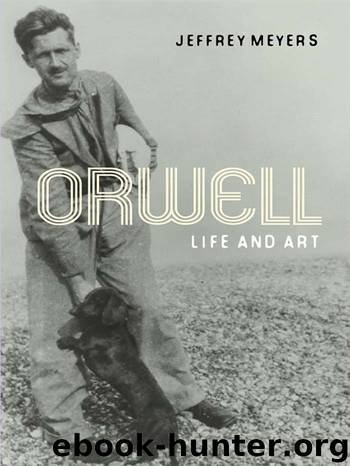
Author:Jeffrey Meyers [Meyers, Jeffrey]
Language: eng
Format: mobi, epub
Tags: Irish, Welsh, English, Literary Criticism, Scottish, European, English; Irish; Scottish; Welsh
ISBN: 9780252090226
Google: eUQ1Z12trIEC
Amazon: B009KAAUIS
Goodreads: 8878352
Publisher: University of Illinois Press
Published: 1999-12-31T11:00:00+00:00
THIRTEEN
THE EVOLUTION OF NINETEEN EIGHTY-FOUR
In this essay I argued forcefully against the prevailing critical opinion that Nineteen Eighty-Four is a “nightmare vision” of a totalitarian future. I believe, instead, that it is a realistic portrayal of the present and the past. Czeslaw Milosz has testified to Orwell's acute perception of contemporary totalitarianism.
I published this piece in English Miscellany, edited in Rome by Mario Praz. One day in Rome, when all the museums were closed, I visited Praz's flat, crammed with art, in the Fondazione Primoli. Short and heavy, with slightly Mongol eyes and dilated nostrils, he impressed me as an immensely learned man (only Donald Greene, of the people I've met, equaled his erudition), not without vanity, who had read everything and knew everything—and had very nearly written about everything.
The most common cliché of Orwell criticism is that Nineteen Eighty-Four is a “nightmare vision” of future totalitarianism.1 I believe, on the contrary, that it is a very concrete and naturalistic portrayal of the present and the past, and that its great originality results more from a realistic synthesis and rearrangement of familiar materials than from any prophetic or imaginary speculations. Nineteen Eighty-Four is not only a paradigm of the history of Europe for the previous twenty years, but also a culmination of all the characteristic beliefs and ideas expressed in Orwell's works from the Depression to the cold war. The origins of the novel can be found in Orwell's earliest books, and its major themes, precise symbols and specific passages can be traced very exactly throughout his writings. For example, Orwell characteristically expresses the poverty and isolation that oppresses the characters in his novels in terms of personal humiliation, so that Winston's frustrating sexual experience with his wife Katharine (who is frigid like Elizabeth in Burmese Days and Dorothy in A Clergyman's Daughter) is exactly like that of Gordon with Rosemary in Keep the Aspidistra Flying.
Orwell felt that he had to evolve a new literary technique in order to frighten people into a recognition of the dangers that threatened their very existence. His statements about Nineteen Eighty-Four reveal that the novel, though set in a future time, is realistic rather than fantastic, and deliberately intensifies the actuality of the present. Orwell wrote that Nineteen Eighty-Four “is a novel about the future—that is, it is in a sense a fantasy, but in the form of a naturalistic novel … [it is] intended as a show-up of the perversions to which a centralised economy is liable, and which have already been partly realised in Communism and fascism…. Totalitarian ideas have taken root in the minds of intellectuals everywhere, and I have tried to draw these ideas out to their logical consequences.”2 Irving Howe (and the “nightmare” critics who follow him) asserts, “it is extremely important to note that the world of Nineteen Eighty-Four is not totalitarianism as we know it, but totalitarianism after its world triumph.”3 It would be more accurate to say that Nineteen Eighty-Four portrays the very real though unfamiliar
Download
This site does not store any files on its server. We only index and link to content provided by other sites. Please contact the content providers to delete copyright contents if any and email us, we'll remove relevant links or contents immediately.
| African | Asian |
| Australian & Oceanian | Canadian |
| Caribbean & Latin American | European |
| Jewish | Middle Eastern |
| Russian | United States |
4 3 2 1: A Novel by Paul Auster(12362)
The handmaid's tale by Margaret Atwood(7744)
Giovanni's Room by James Baldwin(7313)
Asking the Right Questions: A Guide to Critical Thinking by M. Neil Browne & Stuart M. Keeley(5747)
Big Magic: Creative Living Beyond Fear by Elizabeth Gilbert(5739)
Ego Is the Enemy by Ryan Holiday(5406)
The Body: A Guide for Occupants by Bill Bryson(5067)
On Writing A Memoir of the Craft by Stephen King(4924)
Ken Follett - World without end by Ken Follett(4713)
Adulting by Kelly Williams Brown(4560)
Bluets by Maggie Nelson(4541)
Eat That Frog! by Brian Tracy(4509)
Guilty Pleasures by Laurell K Hamilton(4433)
The Poetry of Pablo Neruda by Pablo Neruda(4085)
Alive: The Story of the Andes Survivors by Piers Paul Read(4013)
White Noise - A Novel by Don DeLillo(3999)
Fingerprints of the Gods by Graham Hancock(3982)
The Book of Joy by Dalai Lama(3965)
The Bookshop by Penelope Fitzgerald(3839)
